
Tooth plates and roller segments cast in high manganese steel with TiC-insert alloy bar reinforcement — for sizers, double roll and toothed roll crushers.
A sizer — and a toothed roll crusher — breaks material by shear and tension rather than by compression or impact. Two rolls fitted with toothed plates turn towards each other; the teeth grab the feed, pull it into the gap and break it as the rolls rotate.
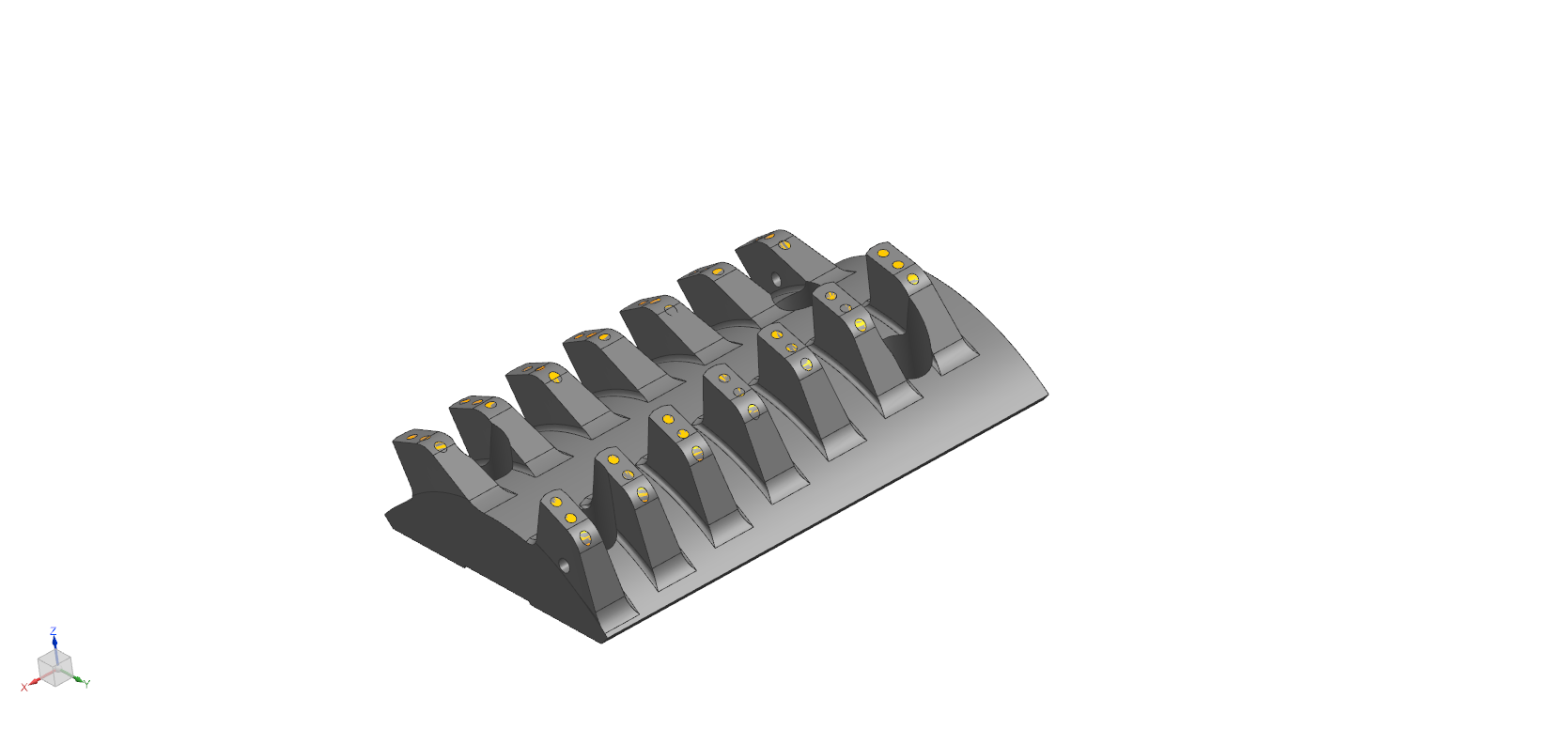
The tooth plates (or roller segments) are the working surface. The tooth tip does the gripping and the breaking, and the gap between the rolls sets the product size — so tooth height and profile translate directly into product change.
That behaviour is why sizers are chosen for sticky, wet or hot material where a jaw or a cone would pack. It is also where they are usually found: coal, coke, limestone, oil shale and ROM mineral sizing.
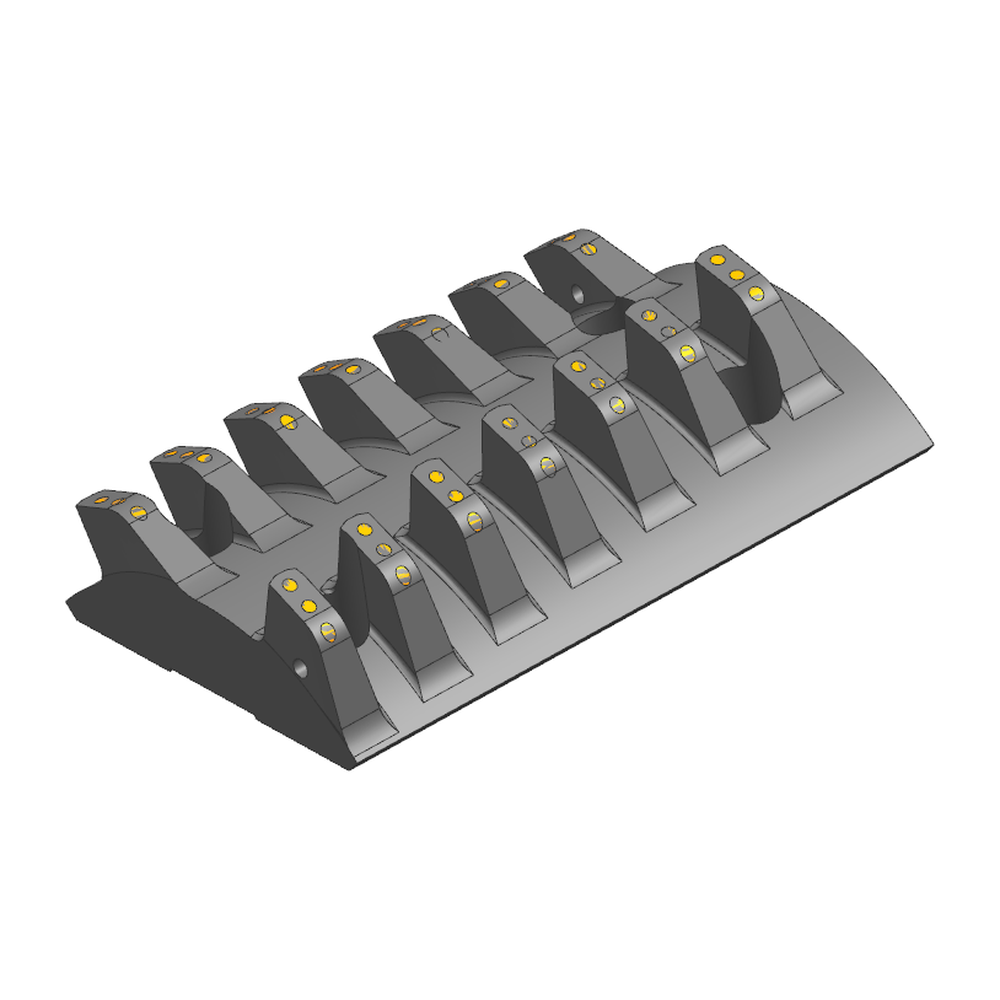
On a sizer the tooth height is part of the machine setting. As the teeth go down, the product goes up.
| Tooth condition | Effective gap | What the plant sees |
|---|---|---|
| New tooth, full height | As set | Product on spec — the roll grips and pulls |
| Half height worn | Opened by the wear | Oversize starts appearing in the size split |
| Tips rounded | Opened further, and no grip | Slip instead of break; recirculating load climbs |
| Tips broken | Uneven across the roll | Local bypass, uneven roll loading, faster wear elsewhere |
Tooth form, height and pitch are quoted against your roll drawing. Send it and we confirm the profile before casting.
On a sizer, the wear part and the machine setting are the same thing. These are the six costs of losing that.
As the teeth wear down the effective gap opens. The size split of the product drifts and the plant starts making oversize.
The tip carries the load and the abrasion at the same point. Wear is rapid, and a broken tip costs the roll its grip locally rather than evenly.
Sizers handle the material other crushers cannot. Wear and build-up both matter, and either one stops the line.
Plates and segments are replaced individually, so a casting that will not hold its bolt holes or its seat is a problem at every change-out.
Access is limited and the parts are heavy. The interval between roll changes is what the operator is really buying.
A cheap plate that loses its teeth early costs more per tonne sized than one that holds its profile for the campaign.
Cost per campaign: a composite tooth plate costs about 1.4× a plain manganese plate and returns roughly 2× the wear life — and lands at about 75% of the price of a carbide-bar composite of the same layout.
| Item | Typical carbide bar composite | CA-Alloy 60 composite |
|---|---|---|
| Wear bar layout | Same pattern | Same pattern |
| Relative price, same layout | 100 | ≈ 75 |
| Hardness (wear bars) | 60–62 HRC | 58–61 HRC |
| Bending strength | ≈ 1900 MPa | 1940 MPa |
| Impact toughness | ≈ 8.1 J/cm² | 9.0–12.0 J/cm² |
| Matrix | High manganese steel | High manganese steel |
Laboratory values for the wear alloy itself, not field-service guarantees. Relative price compares parts of the same layout and fitment; final pricing depends on part weight, cavity and quantity.
A new pattern is proved by casting a single plate and cutting test bars from the same heat. Only a piece that survives that gets a production run of sixty-five more.
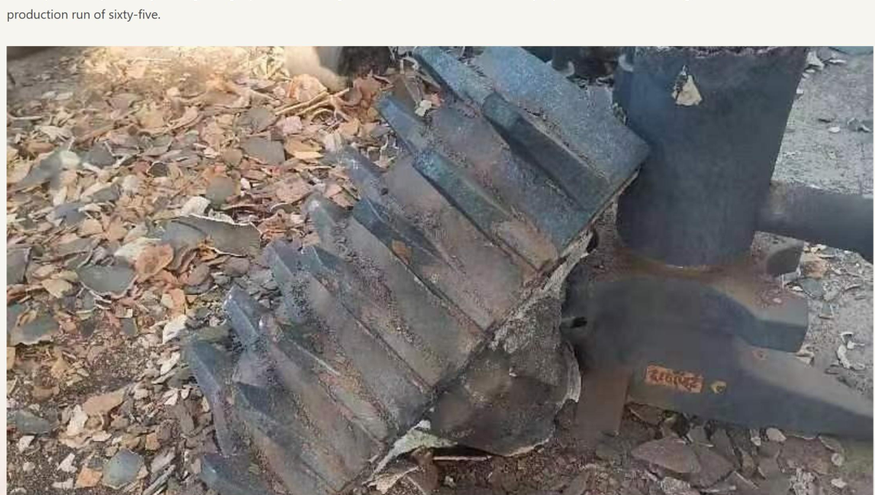
Manganese plate fails from the inside out. A shrink cavity under the tooth root only shows up when the plate is already in service and already paid for — so we open one casting and look, before the other sixty-five exist.
One casting tells us whether the riser feeds the tooth tip, whether the root stays sound, and where the shrink sits — all fixed before the production pattern is cut.
Blocks 1–8 are cut from the trial casting and marked, so every result traces back to its own piece.
Foam pattern cut to the drawing, one plate poured.
Cut through the tooth root; bars taken from the same heat.
Only after the section is clean does the run start.
Shakeout, cleaning, stress relief and machining happen in the same plant — so the heat number on the test bar still matches the plate in the crate.
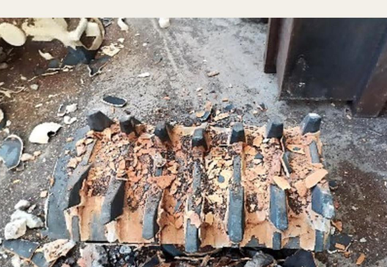
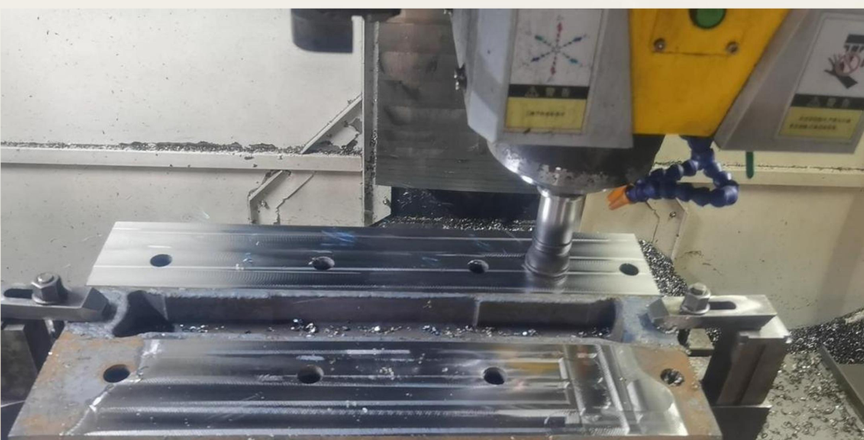
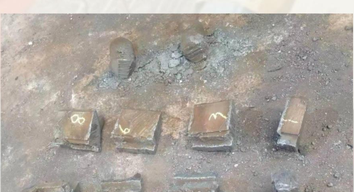
Plates from one pour are cleaned, annealed and machined as a group. The bar that was broken and the bar that was tested carry the same heat number as the plate on the pallet — nothing gets separated.
One set-up per drawing keeps the mounting face true, so the plate lands on the rotor without shimming — which is the failure most often blamed on the casting.
Hardness and impact come off the same casting. Penetrant then covers both faces, and a checking fixture proves the bolt pattern before anything is crated.
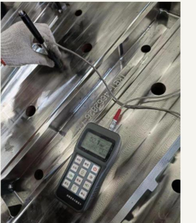
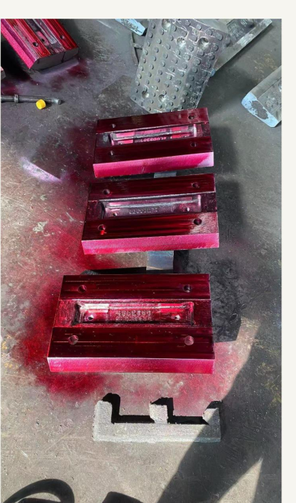
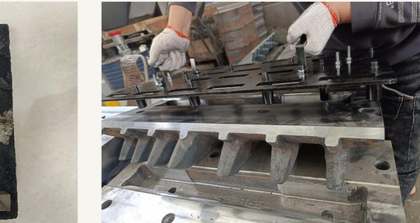
Sizers, double roll and toothed roll crushers. If your machine is not listed, send the part number or a photo and we will confirm it.
Tell us the machine model and the part you are running now, and we will come back with the composite option measured against it.
A part number, a drawing, or a photo of the worn plate with the machine model is enough for us to identify the fitment. Tell us the feed condition — sticky, wet or hot — because that changes how the tooth form should be laid out.
How an order runs: confirm the roll and the tooth form → check the seat and bolt-hole dimensions → 3D-print the pattern and machine the mould → cast, heat-treat, machine and check the fit → segments ship dimension-checked against the drawing.
Send us your tooth plateAll manufacturer names, part numbers, model numbers and descriptions are used for identification and reference purposes only. It is not implied that any part listed is the product of the original manufacturer. Wear performance figures are laboratory values for the wear alloy itself and are not field-service guarantees. Patented in China (CN106282835B).