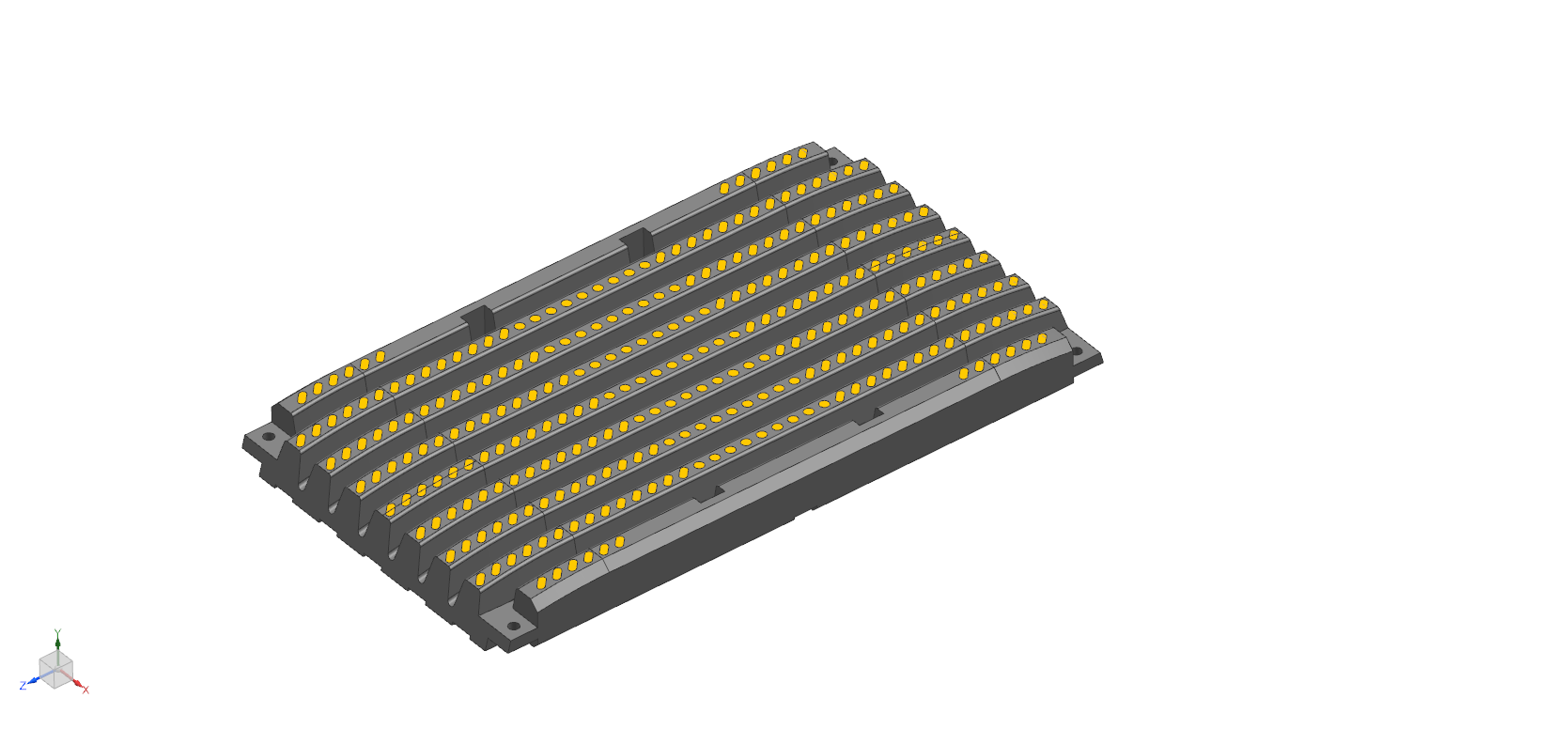
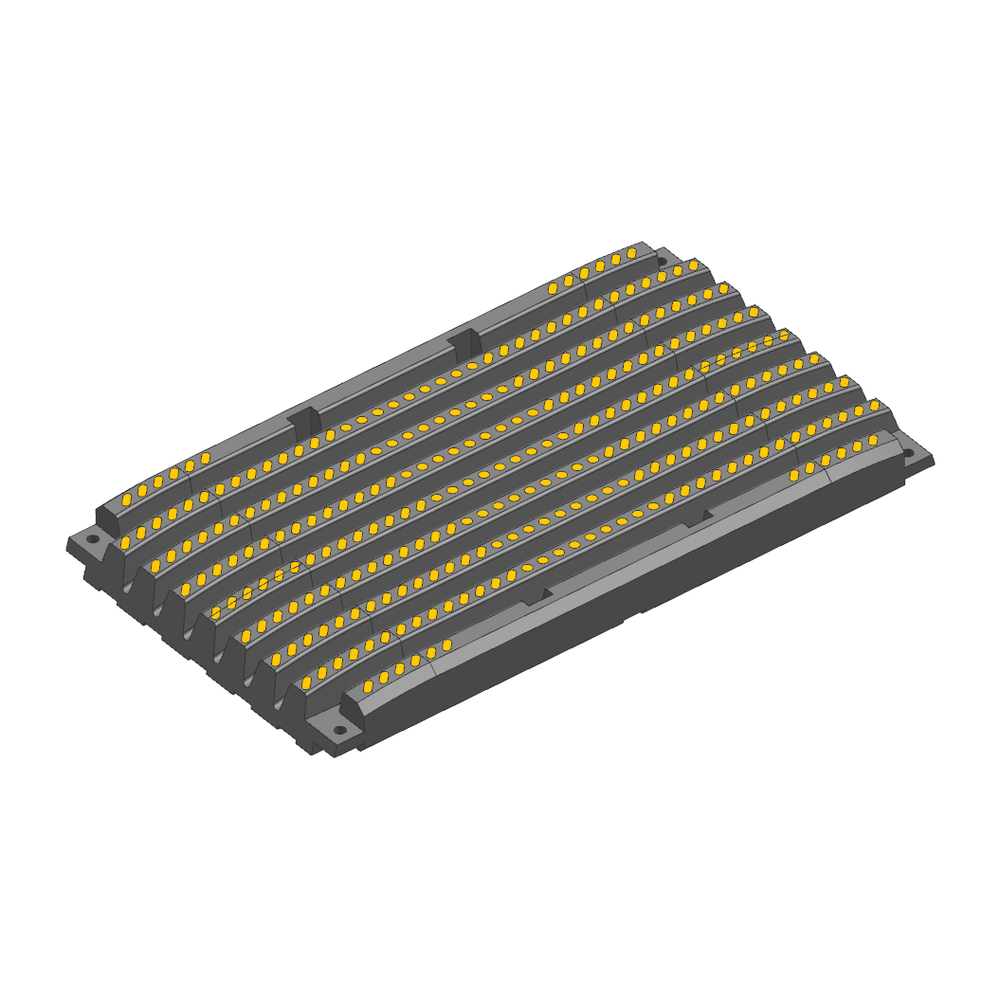
High-chromium carbide castings for sliding-abrasion duty — wear plates, liners, mill parts and components where impact load stays low.
High-chromium carbide castings, typically 20–26% Cr, are the classic answer where the wear is abrasion without heavy impact. The chromium carbides form a hard, dense network in the matrix, and the finished part holds its shape against sliding wear far better than manganese steel does.
Typical parts are wear plates, chute and hopper liners, mill liners and grates, and other components where material slides or rolls across the surface and the load stays low compared with a primary crusher.
The trade is well known: high chrome is hard, but brittle. It does not suit positions with heavy impact, or positions where a part can be dropped and cracked during fitting. Choosing between a chrome casting and a composite part is a question about the duty, not about the catalogue.
The question is never “which material is best”. It is “which material suits this position”. Find your duty in the left column.
| Position and duty | Recommended | Why |
|---|---|---|
| Material slides across the surface, light load chutes, transfer points, hopper liners | Chrome carbide | Sliding abrasion without impact — chrome holds its shape better than manganese does |
| Sliding abrasion plus regular impact blow bars, hammers, jaw dies | Composite (cast-in inserts) | You need the abrasion resistance without the brittleness |
| Heavy impact, uncrushable risk primary crushing, tramp metal | Manganese or composite | Chrome will crack — the matrix has to be able to absorb the hit |
| Fine grinding under pressure mill liners, roll surfaces | Composite or chrome | Depends whether the load is abrasive-rolling or impact-heavy |
| Not sure | Send us the duty | We will tell you which one you should be buying — including when it is not ours |
This page covers the chrome side of the range. If your position takes impact, the composite pages are the better starting point.
Chrome carbide is a good material used in the wrong place. These are the six ways that shows up.
A high-chrome part that cracks on impact or during fitting fails the whole job. Material choice has to follow the duty, not the price list.
Chromium carbide gives sliding-wear resistance, not impact resistance. Specifying it for a high-impact position is the expensive mistake.
High-chrome parts generally cannot be flame-cut or machined in the field, so the as-cast shape and the fit have to be right the first time.
Thermal and mechanical shock crack a chrome casting, and once a part is cracked its life is over.
Wear plate and liner changes cost production hours — especially in a confined transfer point.
The cheapest plate per kilo is rarely the cheapest plate per tonne handled.
Choosing between chrome and composite: if the material slides across the surface and the impact load is light, a chrome carbide casting is usually the economical choice. If the part also takes impact — a blow bar, a hammer or a jaw die — a composite part gives you the abrasion resistance without the brittleness.
| Item | Manganese steel | Chrome carbide |
|---|---|---|
| Wear mechanism it resists | Impact and gouging | Sliding abrasion |
| Behaviour under impact | Work-hardens and absorbs it | Cracks |
| Shape retention in service | Flows and deforms | Holds its form |
| Machining and cutting on site | Can be cut and worked | Generally cannot |
| Where it belongs | Crushing chambers | Liners, chutes and transfer points |
Material selection is confirmed against the duty, not the catalogue. If both could work, we will say which one is cheaper per tonne in that position.
Wear parts for sliding-abrasion duty. If your application is not listed, send the drawing or a photo and we will tell you whether chrome or a composite part is the better buy.
Tell us the machine model and the part you are running now, and we will come back with the composite option measured against it.
A part number, a drawing, or a photo of the worn part with the application is enough for us to identify it. Tell us whether the position takes impact — that is the question that decides the material.
How an order runs: send the drawing or the worn part with the application → we check whether the position takes impact → confirm the material and the section → 3D-print the pattern and machine the mould → cast, heat-treat, machine and inspect.
Send us your drawingAll manufacturer names, part numbers, model numbers and descriptions are used for identification and reference purposes only. It is not implied that any part listed is the product of the original manufacturer. Wear performance figures are laboratory values for the wear alloy itself and are not field-service guarantees. Patented in China (CN106282835B).